Showing posts with label chemistry. Show all posts

Wednesday, July 17, 2013

Good Books to Read

1. The Pathological Protein by Philip Yam (2003)

This is an excellent read if you're interested in diseases and whatnot. The author gives a general overview of transmissible spongiform encephalopathies (TSEs) and their causative agent, the prion. I wouldn't recommend citing this work if you're writing a scientific paper, but it's definitely worth reading. There's a huge amount of background information in the introduction chapters. You can probably skip this if you've taken a few college-level biology classes. I also didn't bother reading the chapters about TSEs affecting deer and elk. I really couldn't care less about some decrepit, senile deer running around aimlessly in a forest preserve. Anyways, this book is great because it explains how Mad Cow Disease started and how it was transmitted to humans. And it mentions how brain-eating cannibals from Papua New Guinea contracted kuru. Who wouldn't be interested in that? These kuru victims are the closest thing to zombies that have ever and will ever exist. Enjoy learning about prions! (They're by far my favorite pathogens!)


2. Packrat: A Tale of Compulsive Hoarding by Tom Hixson (2010)

This book is not for the faint of heart. The author spares no detail when describing the living conditions of an individual suffering from an extreme case of obsessive compulsive hoarding syndrome. The hoarder, Robert, literally kept everything--even things that are meant to be flushed down the toilet. Additionally, the book explains the possible causes and cures of this mental illness. By far, the best chapters are the ones that explain the disorder from a neuroscientific perspective. The brain scans are the best part!

This book is really obscure, and it's haphazardly thrown together. Also, it looks like it was probably printed in some middle-aged guy's mom's basement. Nevertheless, it's a great read. Get a copy if you ever have a chance.  


List of Foods that Still Have trans-Fats

Everyone already knows that trans-fats are evil, but there are still a few things out there that have them. Here's some that I can think of:

1. Cake Frosting and Glazes  

Most of these products have 1.5g of trans-fats per serving. 

2. Milk
I should point out that milk contains a negligible amount of trans-fats. That's why you won't see it listed on the nutritional label.


I can't think of any other foods that have trans-fats, so I guess I'll just write about their chemistry. In the simplest sense, a trans-fat is the trans isomer of a fatty acid. If you don't know about cis-trans isomerism, I'll briefly explain. First of all, this only applies to double bonds. A molecule exhibits cis isomerism when its hydrogens are both on the same side of the double bond. Trans isomerism is the opposite; the hydrogens are across from each other. Here's an example:


Both of these structures represent the chemical called 1,2-dichloroethene. However, they differ slightly. The structure on the left has both hydrogens on the same side of the double bond, and the one of the right has hydrogens across from each other. Therefore, the one on the left is the cis isomer, and the one on the right is the trans isomer. 

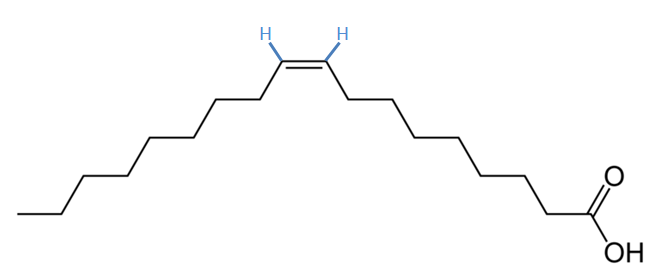
The same concept applies to trans-fats. Here are two more chemical structures: 


Both of these chemicals have a formula of C18H34O2. They only differ in stereochemistry (the spatial arrangement of the atoms within a molecule). The top structure is the trans isomer because the hydrogens are on opposite sides of the double bond, and bottom structure is the cis isomer. You may recognize the top and bottom structures as elaidic acid and oleic acid, respectively. These are the fatty acids that you typically encounter in food items. Elaidic acid is most likely the trans-fat found in the cake frosting above. Its cis isomer, oleic acid, is usually found in plant products like olive oil, for instance. 

No one knows why the trans isomers of fatty acids are so bad for people. According to Wikipedia, humans don't have an enzyme capable of metabolizing the trans isomer, so it builds up in arteries and kills people. I have no idea if that's true or not. There weren't and citations in the article that supported this claim. 

By the way, I gave up italicizing the words cis and trans. I have better things to do with my life than to go back and fix it.     


Saturday, June 29, 2013

Carrots

Someone once told me that baby carrots are really just normal carrots chopped into smaller pieces. I thought that was a lie until now. I was eating some baby carrots when I came across this one:


Apparently, this chunk of carrot escaped the machine that forms baby carrots from larger ones. Now I have proof that baby carrots don't exist naturally. Anyways, this reminds me of something interesting:

Why are carrots orange?

I'm sure everyone has asked this question at some point, but the answer is always indirect. You'll probably hear something like, "They're orange because they have a lot of beta-carotene in them." Well, if anyone has ever wondered why beta-carotene is orange, I can answer that. Here's the chemical structure of beta-carotene: 

beta-Carotene

One of the most obvious characteristics of beta-carotene is its conjugation. Generally, this means that the molecule has alternating single and double bonds. Furthermore, it means that the p-orbitals are overlapping, and electron delocalization is occurring. In other words, the electrons in beta-carotene (and other conjugated systems) are special. These special, delocalized electrons are capable of absorbing photons with wavelengths that correspond to visible light. The reason why carrots are orange is because beta-carotene is capable of absorbing photons with a certain wavelength; this causes humans to perceive them as orange. 

FYI: You might have noticed the structure of beta-carotene closely resembles that of vitamin A. This is because beta-carotene can be a metabolic precursor to vitamin A (aka retinol).